RSA Encoder
9 Jun 2024 github repository
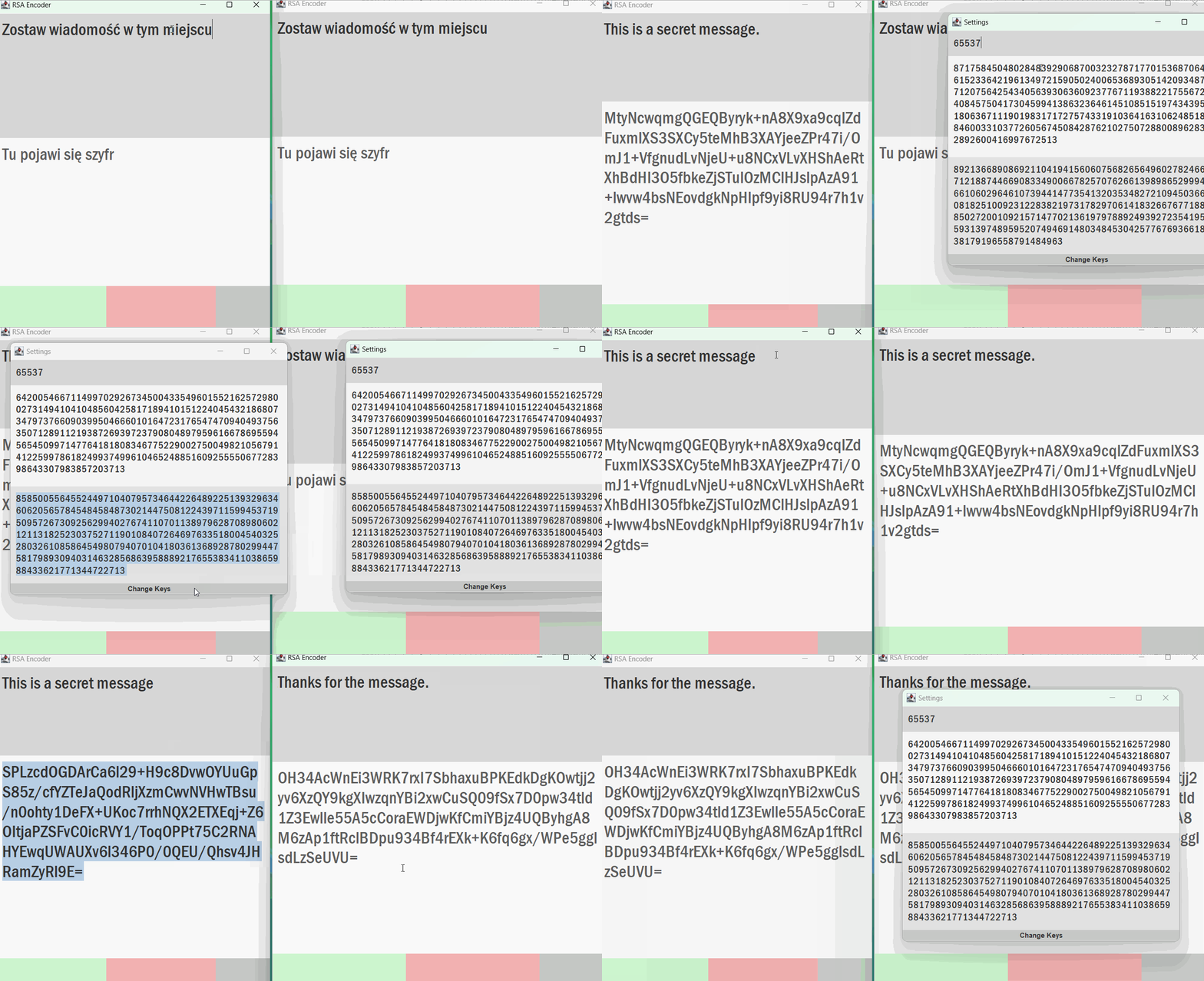
Quick demonstration of the desktop app
Authors
• Dominik Klisiewicz @DominikKlisiewicz
Project Overview
This project features an application which enables the users to encode and decode messages using RSA. GUI contains two text fields, top for the message and bottom for the cypher. The message is encoded using the green button and decoded using the red button. Users may access the randomly generated secret key and parameter n using the grey button. In order to receive messages the keys need to be set to the same values for both clients.
RSA Implementation without external libraries
As it can be seen below, the app was developped without purely with Java and java built in libraries for operations on large numbers.
import java.math.BigInteger;
import java.util.Base64;
import java.security.SecureRandom;

public class RSA
{
    private BigInteger p, q, n, phi, public_key, private_key;
    private int bitlength = 1024;
    private SecureRandom secureRandom = new SecureRandom();
    private int maxMessageLength = bitlength / 8 - 11;

    RSA()
    {
        p = BigInteger.probablePrime(bitlength / 2, secureRandom);
        q = BigInteger.probablePrime(bitlength / 2, secureRandom);
        this.public_key = BigInteger.valueOf(65537);
        this.n = p.multiply(q);
        this.phi = (p.subtract(BigInteger.valueOf(1))).multiply((q.subtract(BigInteger.valueOf(1))));
        if (!this.public_key.gcd(phi).equals(BigInteger.ONE)) {
            this.public_key = BigInteger.probablePrime(bitlength / 2, secureRandom); // Choose another e if gcd != 1
        }
        this.private_key = public_key.modInverse(phi);
    }
    void changeKeys(String publicKey, String privateKey, String n)
    {
    	this.public_key = new BigInteger(publicKey);
        this.private_key = new BigInteger(privateKey);
        this.n = new BigInteger(n);
    }
    void regerateKeys()
    {
        p = BigInteger.probablePrime(bitlength / 2, secureRandom);
        q = BigInteger.probablePrime(bitlength / 2, secureRandom);
        this.public_key = BigInteger.valueOf(65537);
        this.n = p.multiply(q);
        this.phi = (p.subtract(BigInteger.valueOf(1))).multiply((q.subtract(BigInteger.valueOf(1))));
        if (!this.public_key.gcd(phi).equals(BigInteger.ONE)) {
            this.public_key = BigInteger.probablePrime(bitlength / 2, secureRandom); // Choose another e if gcd != 1
        }
        this.private_key = public_key.modInverse(phi);
    }
    BigInteger getPublicKey()
    {
        return this.public_key;
    }

    BigInteger getPrivateKey()
    {
        return this.private_key;
    }

    BigInteger getN()
    {
    	return this.n;
    }

    String encrypt(String message)
    {
        String encodedMessage = stringToBinary(padMessage(message));
        BigInteger messageNumber = new BigInteger(encodedMessage, 2);
        BigInteger cypherBigInt = fastModularExponentiation(messageNumber, public_key, n);
        String cyphertext = Base64.getEncoder().encodeToString(cypherBigInt.toByteArray());
        System.out.println("Długość szyfru: "+cyphertext.length());
        return cyphertext;
    }

    String decrypt(String cyphertext)
    {
        byte[] cypherBytes = Base64.getDecoder().decode(cyphertext);
        BigInteger cypherBigInt = new BigInteger(cypherBytes);
        BigInteger messageNumber = fastModularExponentiation(cypherBigInt, private_key, n);
        String binaryNumber = messageNumber.toString(2);
        String message = binaryToString(binaryNumber);
        return unpadMessage(message);
    }

    private String padMessage(String message)
    {
    	if (message.length() > maxMessageLength)
    	{
    		throw new IllegalArgumentException("Message is too long");
    	}

    	while (message.length() < maxMessageLength)
    	{
    		message += " ";
    	}
    	return message;
    }

    private String unpadMessage(String message)
    {
    	return message.trim();
    }

    private String stringToBinary(String str)
    {
        String binaryString = "";
        for (char c : str.toCharArray()) {
            String binary = String.format("%8s", Integer.toBinaryString(c & 0xFF)).replace(" ", "0");
            binaryString+=binary;
        }
        return binaryString.toString();
    }
    String binaryToString(String binaryString) {
        StringBuilder stringBuilder = new StringBuilder();
        while (binaryString.length() % 8 != 0)
        {
            binaryString = "0" + binaryString;
        }
        for (int i = 0; i < binaryString.length(); i += 8) {
            String binaryChar = binaryString.substring(i, Math.min(i + 8, binaryString.length()));
            int asciiValue = Integer.parseInt(binaryChar, 2);
            char character = (char) asciiValue;
            stringBuilder.append(character);
        }

        return stringBuilder.toString();
    }

    private BigInteger fastModularExponentiation (BigInteger number, BigInteger exponent, BigInteger modValue)
    {
        String binaryExponent = exponent.toString(2);
        BigInteger result = number;
        char current_digit_ch;
        int current_digit;

        for(int i = 1; i < binaryExponent.length(); i++)
        {
            result = result.pow(2).mod(modValue);
            current_digit_ch = binaryExponent.charAt(i);
            current_digit = Character.getNumericValue(current_digit_ch);
            if (current_digit == 1)
            {
                result = result.multiply(number).mod(modValue);
            }
        }
        return result;
    }
}